Born in Santiago, he initially studied architecture at the Pontificia Universidad Católica de Chile in Santiago, but became disillusioned with this occupation and left for Paris in 1933. His travels in Europe and the USA led him to meet artists such as Arshile Gorky, René Magritte, Salvador Dalí, André Breton, and Le Corbusier. Matta was of Spanish, Basque and French descent.
The first true flowering of Matta's own art came in 1938, when he moved from drawing to the oil painting for which he is best known. This period coincided with his emigration to the United States, where he lived until 1948. His early paintings, such as Invasion of the Night, give an indication of the work he would continue, with diffuse light patterns and bold lines on a featureless background. This is also the period of the "inscape" series, and the closely related "psychological morphologies". Prof. Claude Cernuschi (see Boston College Matta exhibition external link below) writes, "Matta's key ambition to represent and evoke the human psyche in visual form was filtered through the writings of Freud and the psychoanalytic view of the mind as a three-dimensional space: the 'inscape'." According to the essay on Matta in Crosscurrents of Modernism (see references below), the inscapes' evocative forms "are visual analogies for the artist's psyche" (p. 241). During the 1940s and 1950s, the disturbing state of world politics found reflection in Matta's work, with the canvases becoming busy with images of electrical machinery and distressed figures. The addition of clay to Matta's paintings in the early 1960s lent an added dimension to the distortions.
It was Breton who provided the major spur to the Chilean's direction in art, encouraging his work and introducing him to the leading members of the Paris Surrealist movement. Matta produced illustrations and articles for Surrealist journals such as Minotaure. During this period he was introduced to the work of many prominent contemporary European artists, such as Pablo Picasso and Marcel Duchamp.
Throughout his life, Matta worked with many different types of media, including ceramic, photography, and video production.
In his art Matta creates new dimensions in a blend of organic and cosmic lifeforms (see biomorphism). He was one of the first artists to take this abstract leap.
Friday, October 28, 2011
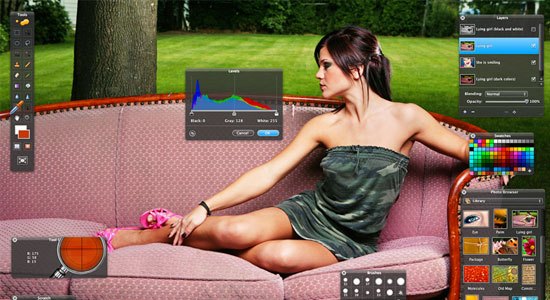
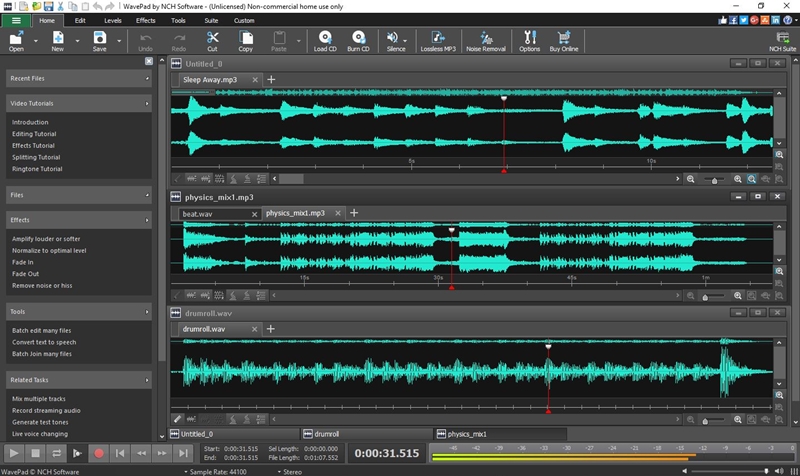
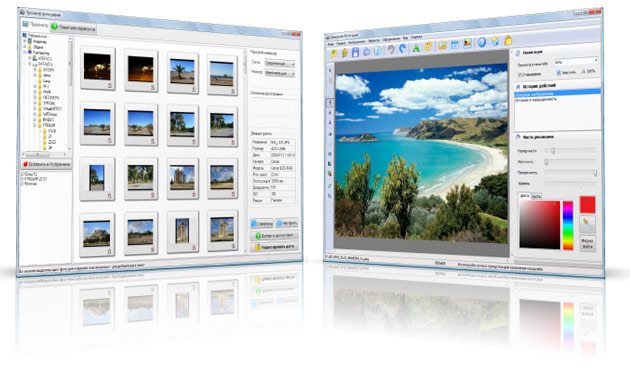
image editing software
If interlacing is used, each stage of the interlacing is filtered separately, meaning that the image can be progressively rendered as each stage is received; however, interlacing generally makes compression less effective.
As some tools are PNG-specific, while others only optimize DEFLATE, in general one must use a combination of 2 tools in sequence for optimal compression: one which optimizes filters (and removes ancillary chunks), and one which optimizes DEFLATE. Most commonly, OptiPNG is used for the first (non-DEFLATE) step, and either of AdvanceCOMP or PNGOUT is used for the DEFLATE step.
The case of the second letter indicates if the chunk is "public" (either in the specification or the registry of special purpose public chunks) or "private" (not standardised). Uppercase is public and lowercase is private. This ensures that public and private chunk names can never conflict with each other (although two private chunk names could conflict).
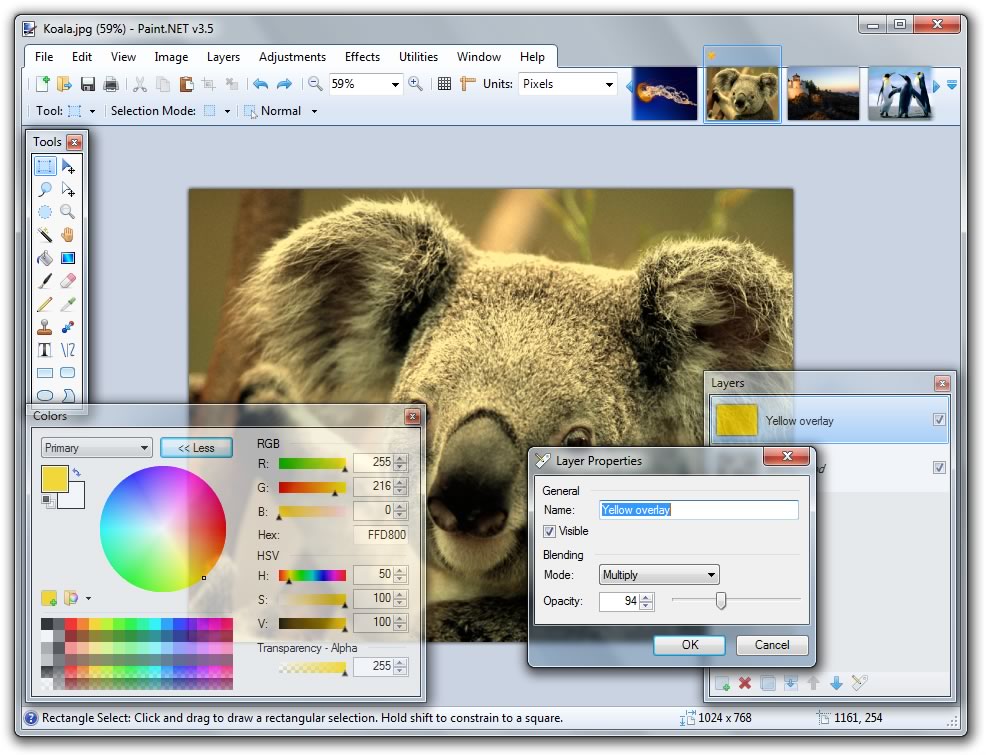
Popular graphics programs which support the PNG format include Adobe Photoshop, Corel's Photo-Paint and Paint Shop Pro, the GIMP, GraphicConverter, Helicon Filter, Inkscape, IrfanView, Pixel image editor, Paint.NET and Xara. Some programs bundled with popular operating systems which support PNG include Microsoft's Paint and Apple's iPhoto and Preview, with the GIMP also often being bundled with popular Linux distributions.
Wrapper tools that simplify this workflow include: ImageOptim, a GUI front-end for Mac OS X; Kashmir Web Optimizer- GUI front-end for Windows; imgopt, a command-line shell script that also losslessly optimizes JPEG images; and Smush.it, an image-optimizing web service.
As some tools are PNG-specific, while others only optimize DEFLATE, in general one must use a combination of 2 tools in sequence for optimal compression: one which optimizes filters (and removes ancillary chunks), and one which optimizes DEFLATE. Most commonly, OptiPNG is used for the first (non-DEFLATE) step, and either of AdvanceCOMP or PNGOUT is used for the DEFLATE step.
The case of the second letter indicates if the chunk is "public" (either in the specification or the registry of special purpose public chunks) or "private" (not standardised). Uppercase is public and lowercase is private. This ensures that public and private chunk names can never conflict with each other (although two private chunk names could conflict).
Popular graphics programs which support the PNG format include Adobe Photoshop, Corel's Photo-Paint and Paint Shop Pro, the GIMP, GraphicConverter, Helicon Filter, Inkscape, IrfanView, Pixel image editor, Paint.NET and Xara. Some programs bundled with popular operating systems which support PNG include Microsoft's Paint and Apple's iPhoto and Preview, with the GIMP also often being bundled with popular Linux distributions.
Wrapper tools that simplify this workflow include: ImageOptim, a GUI front-end for Mac OS X; Kashmir Web Optimizer- GUI front-end for Windows; imgopt, a command-line shell script that also losslessly optimizes JPEG images; and Smush.it, an image-optimizing web service.
Thursday, October 27, 2011
Name Kajol Wallpaper Pack 2
Devgn's 1999 work included Sanjay Leela Bhansali's Hum Dil De Chuke Sanam as well as "Hindustan ki kasam" and "Kachche dhage".
In 1995, he appeared in Mahesh Bhatt's "Naajayaz", for which he was nominated for "filmfare best actor award". In 1996, he continued with "Diljale".
Anil Kapoor (2001) · Murali (2002) · Ajay Devgn (2003) · Vikram (2004) · Saif Ali Khan (2005) · Amitabh Bachchan (2006) · Soumitra Chatterjee (2007) · Prakash Raj (2008) · Upendra Limaye (2009) · Amitabh Bachchan (2010) · Dhanush and Salim Kumar (2011)
In 1994, Devgn worked in Harry Baweja's Dilwale, Suhaag and Vijaypath".
In 1995, he appeared in Mahesh Bhatt's "Naajayaz", for which he was nominated for "filmfare best actor award". In 1996, he continued with "Diljale".
Anil Kapoor (2001) · Murali (2002) · Ajay Devgn (2003) · Vikram (2004) · Saif Ali Khan (2005) · Amitabh Bachchan (2006) · Soumitra Chatterjee (2007) · Prakash Raj (2008) · Upendra Limaye (2009) · Amitabh Bachchan (2010) · Dhanush and Salim Kumar (2011)
In 1994, Devgn worked in Harry Baweja's Dilwale, Suhaag and Vijaypath".
Subscribe to:
Posts (Atom)